Commercial glazing · mainland UK
Commercial glazing, specified properly
Curtain walling, shopfronts, structural glazing, fire-rated systems, partitions and emergency response — surveyed on site, specified against the standard that applies, and installed by a team that only does commercial work.
- Free measured survey, then a fixed written quotation
- Specification named in writing — system, glass build-up, standard and lead time
- Occupied buildings, phased and out-of-hours working as standard
- 24-hour emergency make-safe across mainland UK
Free survey · no obligation · same working day response
Tell us about the project
Straight answer, same working day.
- Free measured site survey
- Fixed written quotation
- Mainland UK coverage
- Commercial specialists only
- 24-hour emergency response
Commercial glazing covers the glazed elements of a non-domestic building — facade, entrance, internal screens and roof. Each element is governed by a different standard, and the specification, not the glass price, is what determines whether it performs.
What we do, and how we price it
Every page on this site carries the specification detail and an indicative price band for that type of work, because the most common question we are asked is what something should cost before anyone commits to a survey.
Those bands are budget figures drawn from typical rates. They are not quotations, and we do not pretend a building can be priced without seeing it. What they will tell you is whether the work you are considering is a five-figure job or a six-figure one, which is usually the decision that matters at the point you are asking.
Commercial only, and that changes things
Commercial glazing is not heavy-duty domestic glazing. The openings are larger, the panels are heavier, the hardware cycles hundreds of times a day, and almost every element sits under a regulation — Part K for impact, Part B for fire, Part M for access, Part L for thermal, BS EN 16005 for powered doors, BS 6180 for barriers.
We work from that framework rather than from a product catalogue, which is why the first thing you get from us is usually a question about the building rather than a price for a product.
Services
Twelve things we are asked for most
Each page carries the standards that apply, a real specification block and an indicative rate.
Curtain walling
Curtain walling is a non-loadbearing aluminium and glass facade hung off the structural frame of a building.
02Commercial shopfronts
A commercial shopfront is the glazed street elevation of a retail or hospitality unit, normally thermally broken aluminium framing with toughened or laminated safety glass, an accessible entrance door and, on most units, a security shutter or grille.
03Structural glazing
Structural glazing carries load through the glass itself rather than through a surrounding frame.
04Automatic doors
An automatic door is a powered entrance — sliding, swing or telescopic — controlled by activation and safety sensors and governed by BS EN 16005.
05Fire-rated glazing
Fire-rated glazing is a tested assembly of glass, frame, seals and fixings that holds back fire for a stated period.
06Toughened & laminated safety glass
Safety glass is glass that fails without causing serious injury.
07Double glazed unit replacement
A double glazed unit, or IGU, is two panes bonded to a spacer bar with a sealed cavity between them.
08Glass balustrades
A glass balustrade is a protective barrier where a fall is possible, built from laminated toughened glass either clamped in a base channel or fixed on standoffs.
09Glass partitions
A glass partition is a non-loadbearing internal screen that divides a floor plate without blocking light.
10Roof glazing and rooflights
Roof glazing is any glazed element in a roof plane — rooflights, atrium glazing, lanterns and walk-on panels.
11Emergency glazing and board-up
Emergency glazing is the immediate response to broken glass on a commercial building: make the area safe, remove the remaining glass, and secure the opening the same visit.
12Commercial aluminium windows and doors
Commercial aluminium windows and doors are thermally broken framed units built for heavy use — far higher cycle ratings, wider spans and stronger hardware than residential equivalents, with a polyamide break separating inner and outer frame.
By building type
What changes by sector
The same service behaves very differently in a live ward, a trading shop and a working warehouse. These pages cover what actually changes.
Offices and workplace
Office glazing splits into two very different jobs: the facade, which is a construction project with weather and programme risk, and the internal fit-out, which is an occupied-building exercise measured in noise, dust and disruption.
Retail and high street
Retail glazing is judged on two things: how the frontage looks from twenty feet away, and how fast it can be made secure at two in the morning.
Schools and education
Education glazing is governed by two constraints that override everything else: it has to be safe for children who will test it, and it has to be finished inside a holiday window that does not move.
Healthcare and NHS
Healthcare glazing is planned around the ward, not the programme.
Hotels and hospitality
In hospitality the glazing is judged by a guest at two in the morning.
Industrial and logistics
Industrial glazing is mostly about two things people rarely think of as glazing: daylight through the roof, and keeping a warehouse operating while any of it is replaced.
Leisure and fitness
Leisure buildings put glazing under conditions almost nothing else does: constant humidity, chlorine, heavy impact and, in spectator areas, crowd loading on the barriers.
Public sector and local authority
Public estates need two things from a glazing contractor that private clients rarely ask for: documentation that survives an audit, and a reactive service that can attend a vandalised building on a bank holiday.
How it runs
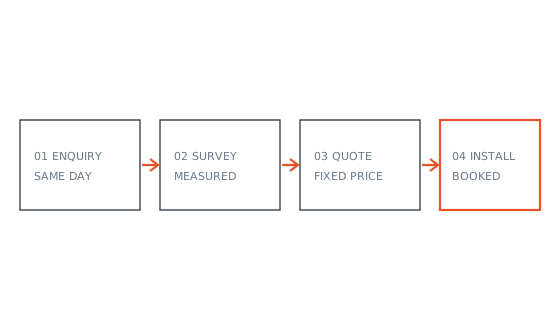
What happens after you call
You call or send the details
Tell us the building, the work and the postcode. We come back the same working day.
We survey and measure
A measured survey on site, at no cost and with no obligation. Access and phasing are assessed at the same visit.
You get a fixed written quotation
Itemised, with the specification named — glass build-up, system, standards and lead time.
We book it and install
A confirmed date, an agreed working window, and the certification handed over on completion.
Technical guides
The questions worth answering before you specify
Stick vs unitised curtain walling
Stick curtain walling is assembled from loose components on site; unitised curtain walling arrives as factory-glazed storey-height cassettes.
Fire rated glass ratings explained
Fire glazing is classified under BS EN 13501-2.
Part K critical locations
Building Regulations Part K requires safety glass in critical locations — broadly, any glazing below 800mm from floor level, and any glazing within 300mm of a door edge up to 1500mm from floor level, where impact is likely.
U-values and Part L for commercial glazing
Part L is assessed on the whole window or the whole facade, frame included — not on the centre-pane figure printed on the unit label.
Acoustic glazing and what it costs
A standard 4-16-4 double glazed unit gives roughly 30dB of sound reduction.
Laminated vs toughened glass
Toughened glass is stronger before it breaks and disintegrates into blunt granules when it does.
Commercial glazing — common questions
What counts as commercial glazing?
How much does commercial glazing cost?
Do you charge for a survey?
Can you work in an occupied building?
How quickly can you attend an emergency?
Do you provide certification for fire-rated work?
Coverage
Where we work
Mainland UK. These are the cities we are asked about most — each page covers what is specific to that building stock.
Tell us what the building needs
Free measured survey, fixed written quotation, and a straight answer about what is and is not worth doing. Mainland UK, commercial work only.