Service
Automatic doors
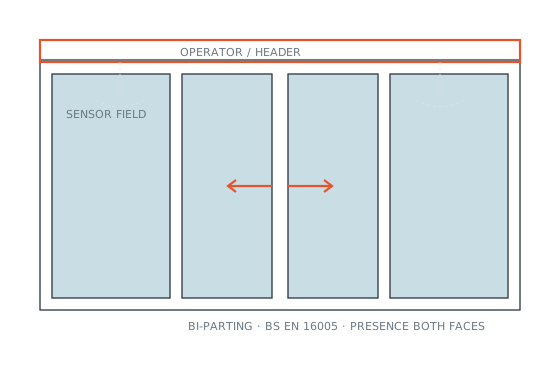
An automatic door is a powered entrance — sliding, swing or telescopic — controlled by activation and safety sensors and governed by BS EN 16005. It must fail safe, detect a person standing in the opening, and be safety-checked at least annually.
Free measured survey · fixed written quotation
- Free measured site survey
- Fixed written quotation
- Mainland UK coverage
- Commercial specialists only
- 24-hour emergency response
BS EN 16005 is where most existing doors fail
Almost every automatic door we survey on an older building fails at least one point of BS EN 16005. The usual ones are missing presence detection on the swing side, sensor blind spots at the leading edge, and finger-trap gaps at the closing stile.
The standard puts a duty on whoever operates the building, not on whoever installed the door. It also requires a competent safety check at least annually, with records. If an incident happens and there are no records, the position is very difficult to defend.
Escape routes change the specification entirely
A powered door on a designated escape route has to release under power failure and let people out without special knowledge. That is achieved with break-out leaves that swing through in the direction of escape, or a fail-safe unlock tied into the fire alarm.
This is decided at design stage with the fire strategy, not chosen from a price list. Retrofitting escape compliance onto the wrong operator usually means changing the operator.
Low energy operators for accessible doors
Where the requirement is accessibility rather than throughput — an accessible WC lobby, an internal cross-corridor door, a small entrance — a low-energy swing operator on a push pad is often the better answer. It opens slowly enough that presence sensors are not needed, costs a fraction of a sliding set, and can be fitted to a good existing door leaf.
Specification
| Standard | BS EN 16005 (power operated doorsets — safety in use) |
|---|---|
| Configurations | Single slide, bi-parting slide, telescopic, swing operator, low-energy |
| Sensors | Combined activation and presence detection both faces |
| Clear opening | 900mm–2400mm typical for bi-parting |
| Glass | Toughened or laminated safety glass, manifested to Part K |
| Fail mode | Break-out leaves or fail-safe unlock where used on an escape route |
| Duty cycle | Standard operators rated to 500,000+ cycles |
| Service interval | Minimum annual safety check — legal requirement in use |
Indicative rate
Supply and install of a complete set including operator, sensors, glass and commissioning. Escape-route interfacing, fire alarm links and lobby configurations are additional.
Indicative range for budgeting — not a quotation
Automatic doors — common questions
How often do automatic doors legally need servicing?
Can an existing manual door be automated?
What happens to an automatic door in a power cut?
Why does my automatic door keep opening on its own?
How long does an automatic door installation take?
Related
Where this comes up
Offices and workplace
Office glazing splits into two very different jobs: the facade, which is a construction project with weather and programme risk, and the internal fit-out, which is an occupied-building exercise measured in noise, dust and disruption.
Retail and high street
Retail glazing is judged on two things: how the frontage looks from twenty feet away, and how fast it can be made secure at two in the morning.
Healthcare and NHS
Healthcare glazing is planned around the ward, not the programme.
Hotels and hospitality
In hospitality the glazing is judged by a guest at two in the morning.
Other services
Curtain walling
Curtain walling is a non-loadbearing aluminium and glass facade hung off the structural frame of a building.
Commercial shopfronts
A commercial shopfront is the glazed street elevation of a retail or hospitality unit, normally thermally broken aluminium framing with toughened or laminated safety glass, an accessible entrance door and, on most units, a security shutter or grille.
Structural glazing
Structural glazing carries load through the glass itself rather than through a surrounding frame.
Tell us what the building needs
Free measured survey, fixed written quotation, and a straight answer about what is and is not worth doing. Mainland UK, commercial work only.