Service
Toughened and laminated safety glass
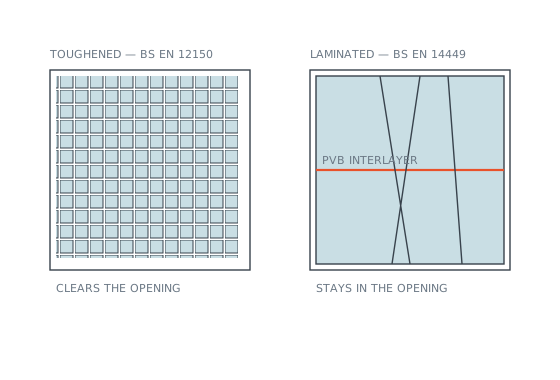
Safety glass is glass that fails without causing serious injury. Toughened glass breaks into blunt granules; laminated glass cracks but stays bonded to its interlayer. Building Regulations Part K requires one or the other in critical locations.
Free measured survey · fixed written quotation
- Free measured site survey
- Fixed written quotation
- Mainland UK coverage
- Commercial specialists only
- 24-hour emergency response
Where Part K actually applies
Critical locations are defined by height and proximity to a door. Broadly: anything glazed below 800mm from floor level, and anything within 300mm of a door edge up to 1500mm from floor level. Those are the positions where someone walking into the glass is likely.
In practice this catches shopfronts, entrance screens, side panels beside doors, low-level office partition glazing and most balustrade work. Older commercial buildings frequently have annealed float glass in all of these positions, which is a live liability rather than a cosmetic issue.
Toughened or laminated — they fail very differently
Toughened glass is four to five times stronger than annealed and, when it does break, disintegrates completely into small blunt pieces. That is safe for the person, but it clears the opening instantly — no security, no weather protection, and anything above it is now unsupported.
Laminated glass is not as strong but holds together on its interlayer when cracked. It keeps the opening closed, keeps the building secure, and stays in place overhead. For anything at street level, overhead, or where a fall is possible, laminated is normally the right answer even though it costs more.
Everything is decided before toughening
A toughened pane cannot be cut, drilled, notched or edge-worked afterwards — any of those will shatter it. Every hole, cut-out and edge finish has to be right on the order.
This is why accurate site survey matters more here than almost anywhere else, and why a 5mm error on a measured opening means a remake rather than a trim on site.
Specification
| Standards | BS EN 12150 (toughened), BS EN 14449 (laminated), BS EN 12600 (impact) |
|---|---|
| Impact classes | Class 3, 2 or 1 — Class 1 is the highest performance |
| Critical locations | Below 800mm generally; below 1500mm in and beside doors |
| Toughened thickness | 4mm–19mm, typically 6mm or 10mm commercially |
| Laminated build-ups | 6.4mm, 8.8mm, 11.5mm — PVB or stiffer SentryGlas interlayer |
| Marking | Permanent kitemark or CE/UKCA stamp in a corner of every pane |
| Heat soaking | BS EN 14179 — advised for overhead and structural work |
| Post-toughening | No cutting, drilling or edge work possible after toughening |
Indicative rate
Supply and install of glass into existing sound framing. Access, out-of-hours working, oversized panes and specialist interlayers are additional.
Indicative range for budgeting — not a quotation
Toughened & laminated safety glass — common questions
How can I tell if existing glass is safety glass?
Is toughened glass or laminated glass stronger?
Does safety glass stop a break-in?
Can annealed glass be upgraded without replacing it?
Why did my toughened glass shatter for no reason?
Related
Where this comes up
Retail and high street
Retail glazing is judged on two things: how the frontage looks from twenty feet away, and how fast it can be made secure at two in the morning.
Schools and education
Education glazing is governed by two constraints that override everything else: it has to be safe for children who will test it, and it has to be finished inside a holiday window that does not move.
Healthcare and NHS
Healthcare glazing is planned around the ward, not the programme.
Industrial and logistics
Industrial glazing is mostly about two things people rarely think of as glazing: daylight through the roof, and keeping a warehouse operating while any of it is replaced.
Other services
Curtain walling
Curtain walling is a non-loadbearing aluminium and glass facade hung off the structural frame of a building.
Commercial shopfronts
A commercial shopfront is the glazed street elevation of a retail or hospitality unit, normally thermally broken aluminium framing with toughened or laminated safety glass, an accessible entrance door and, on most units, a security shutter or grille.
Structural glazing
Structural glazing carries load through the glass itself rather than through a surrounding frame.
Tell us what the building needs
Free measured survey, fixed written quotation, and a straight answer about what is and is not worth doing. Mainland UK, commercial work only.