Service
Fire-rated glazing
Fire-rated glazing is a tested assembly of glass, frame, seals and fixings that holds back fire for a stated period. Ratings are given as E (integrity), EW (integrity plus reduced radiation) and EI (integrity plus insulation), with a time in minutes.
Free measured survey · fixed written quotation
- Free measured site survey
- Fixed written quotation
- Mainland UK coverage
- Commercial specialists only
- 24-hour emergency response
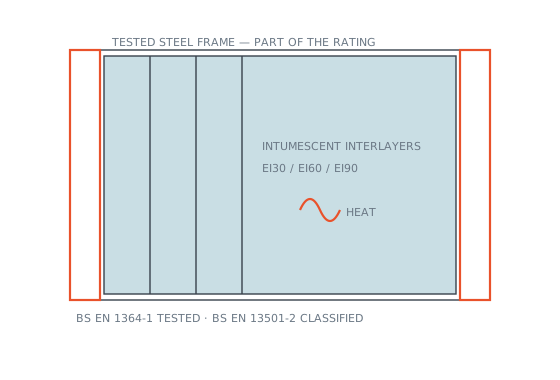
The rating belongs to the whole assembly, not the glass
This is the single most misunderstood point in fire glazing. An EI60 pane in an untested frame with the wrong seals and the wrong fixings is not EI60 — it has no rating at all. The test evidence covers the exact combination of glass, frame, beads, gaskets, fixings and maximum pane size.
Substituting any element voids the evidence. We install to the tested specification and hand over the certification that names it, because at building control sign-off or after an incident that paperwork is the only thing that counts.
Integrity, insulation and why EI costs more than E
E means the assembly holds back flame and hot gases. EW adds a limit on the heat radiating through, so people can pass closer to it. EI adds insulation — the unexposed face stays cool enough that you could stand against it.
EI is what protected escape corridors normally need, and it is materially more expensive because it needs intumescent layers that expand and opacify in a fire. Specifying EI where E would do is one of the most common ways to waste money on a project.
Where fire glazing usually gets specified
Protected stairwells and lobbies, cross-corridor screens, atrium separation, plant and electrical rooms, and any glazing that forms part of a compartment line. In refurbishment, the most common trigger is a change of use or a new fire strategy identifying a compartment wall that was never rated.
We work from the fire strategy rather than guessing. If there isn't one, that is the thing to resolve before the glazing is priced.
Specification
| Standards | BS EN 1364-1 (test), BS EN 13501-2 (classification) |
|---|---|
| Common ratings | E30, EW30, EI30, EI60, EI90, EI120 |
| Glass types | Intumescent interlayer laminates, gel-filled units, borosilicate |
| Frames | Tested steel, timber or fire-rated aluminium — never mixed |
| Typical thickness | 15mm (EI30) to 40mm+ (EI120) |
| Maximum pane sizes | Set by the test evidence for that exact system |
| Marking | Every pane permanently marked with its classification |
| Documentation | Test certificate and installation record issued on completion |
Indicative rate
Supply and install of a tested system. EI60 and above, doorsets, curved work and acoustic-plus-fire specifications sit at the upper end and beyond.
Indicative range for budgeting — not a quotation
Fire-rated glazing — common questions
What is the difference between EI30 and EW30?
Can Georgian wired glass still be used?
Does fire-rated glazing have to be marked?
Can fire-rated glazing also be acoustic or safety glass?
How long does a fire screen take to supply?
Related
Where this comes up
Schools and education
Education glazing is governed by two constraints that override everything else: it has to be safe for children who will test it, and it has to be finished inside a holiday window that does not move.
Healthcare and NHS
Healthcare glazing is planned around the ward, not the programme.
Public sector and local authority
Public estates need two things from a glazing contractor that private clients rarely ask for: documentation that survives an audit, and a reactive service that can attend a vandalised building on a bank holiday.
Other services
Curtain walling
Curtain walling is a non-loadbearing aluminium and glass facade hung off the structural frame of a building.
Commercial shopfronts
A commercial shopfront is the glazed street elevation of a retail or hospitality unit, normally thermally broken aluminium framing with toughened or laminated safety glass, an accessible entrance door and, on most units, a security shutter or grille.
Structural glazing
Structural glazing carries load through the glass itself rather than through a surrounding frame.
Tell us what the building needs
Free measured survey, fixed written quotation, and a straight answer about what is and is not worth doing. Mainland UK, commercial work only.