Service
Commercial shopfronts
A commercial shopfront is the glazed street elevation of a retail or hospitality unit, normally thermally broken aluminium framing with toughened or laminated safety glass, an accessible entrance door and, on most units, a security shutter or grille.
Free measured survey · fixed written quotation
- Free measured site survey
- Fixed written quotation
- Mainland UK coverage
- Commercial specialists only
- 24-hour emergency response
Getting the entrance right before anything else
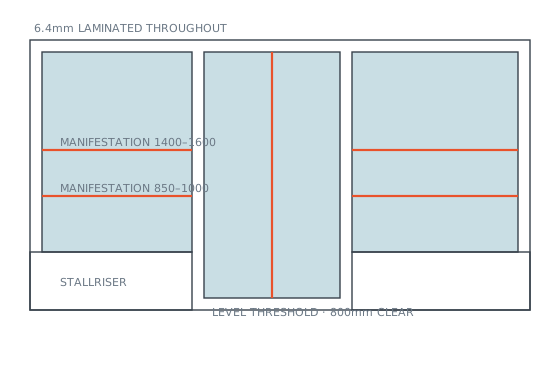
The entrance is where a shopfront quietly passes or fails. Part M asks for a level or gently ramped threshold, an 800mm clear opening and an opening force light enough for a wheelchair user to manage unaided. Retrofit a heavy manual door onto an old stepped threshold and the unit is not compliant, however good the glass looks.
On high-footfall units the answer is usually an automatic sliding set. On smaller units a well-specified swing door with a back-check closer and a low-rise threshold does the job at a fraction of the cost.
Manifestation is a legal requirement, not decoration
Full-height glazing has to be marked so it is visible to someone approaching it. Part K asks for manifestation in two bands, roughly 850–1000mm and 1400–1600mm from floor level, in a contrast that reads against whatever is behind the glass.
Vinyl branding usually satisfies this and looks intentional rather than bolted on. Frosted bands, etched logos and printed film all work. What does not work is a single small logo at eye height on an otherwise clear wall of glass.
Listed buildings and conservation areas
In a conservation area or on a listed unit the shopfront is normally the most heavily controlled element of the whole building. Expect conditions on frame colour, sightline width, stallriser height, signage zone and whether an external shutter is permitted at all.
Internal shutters, timber-effect powder coating and slimline heritage sections usually get through where a standard commercial front will not. Getting the specification agreed with the conservation officer before manufacture saves a great deal of money.
Specification
| Framing | Thermally broken aluminium, 45mm–70mm sightlines |
|---|---|
| Glass | 6.4mm laminated or 10mm toughened, manifested to Part K |
| Entrance door | Level threshold, 800mm clear opening minimum for Part M |
| Opening force | Under 30N to open, under 22.5N through the swing |
| Security | Optional roller shutter, lattice grille or laminated attack-resistant glazing |
| Standards | Part K (safety glazing), Part M (access), PAS 24 where security is specified |
| Finish | Powder coat to BS EN 12206 or anodised, dual colour available |
| Typical lead time | 3–5 weeks from signed survey to install |
Indicative rate
Supply and install of framing and glass at ground level. Automatic doors, shutters, feature entrances and out-of-hours working are additional.
Indicative range for budgeting — not a quotation
Commercial shopfronts — common questions
How long does a shopfront take to install?
Can a shopfront be replaced while the shop stays open?
Do I need planning permission for a new shopfront?
What glass should a shopfront use?
Is a roller shutter still worth fitting?
Related
Where this comes up
Retail and high street
Retail glazing is judged on two things: how the frontage looks from twenty feet away, and how fast it can be made secure at two in the morning.
Hotels and hospitality
In hospitality the glazing is judged by a guest at two in the morning.
Other services
Curtain walling
Curtain walling is a non-loadbearing aluminium and glass facade hung off the structural frame of a building.
Structural glazing
Structural glazing carries load through the glass itself rather than through a surrounding frame.
Automatic doors
An automatic door is a powered entrance — sliding, swing or telescopic — controlled by activation and safety sensors and governed by BS EN 16005.
Tell us what the building needs
Free measured survey, fixed written quotation, and a straight answer about what is and is not worth doing. Mainland UK, commercial work only.